What EMDR Hand Buzzers Do
In EMDR therapy, "buzzers" refer to small handheld devices that alternately vibrate left and right — a category closely related to EMDR tappers. The client holds one in each hand. The therapist controls the pacing — slow for grounding and resourcing, faster during active reprocessing. This left-right alternation, called bilateral stimulation (BLS), is central to how EMDR works.
Tactile buzzers are popular because many clients find them easier to work with than tracking a moving visual target. The physical sensation keeps them grounded and present, which is exactly the dual-attention state EMDR relies on: one part of the mind attending to the memory, another anchored in the safe present.
Why Haptic Quality Matters
Not all buzzing is equal. Cheap EMDR hand buzzers — the kind you find on Amazon for $30–$60 — often use eccentric rotating mass (ERM) motors, the same mechanism as an old feature phone. The sensation is generic rumble rather than a clean, localized tap. Worse, many don't truly alternate: both hands vibrate simultaneously, or the timing drifts so that the left-right distinction becomes unclear. When stimulation is muddled, it's harder for clients to stay in the bilateral rhythm.
Joy-Con controllers use linear resonance actuators (LRAs) — the same class of haptic hardware as the iPhone's Taptic Engine. LRAs produce distinct, well-defined taps with precise timing. When TheraJoy drives them with alternating haptic patterns, each controller fires cleanly one at a time. The alternation is perceptible and consistent.
TheraJoy as a Set of Bilateral Stimulation Buzzers
TheraJoy is an iPhone app that turns a pair of Joy-Con controllers into EMDR buzzers. The therapist opens the app, sets the pacing, and the Joy-Cons in the client's hands begin alternating. Speed is adjustable from 0.25 to 3 Hz. Intensity has multiple levels. The session runs from the therapist's phone or — for teletherapy — the client joins remotely via a shared session code while the therapist controls pacing.
If you've been searching for EMDR hand buzzers, bilateral stimulation buzzers, or EMDR buzzers for sale, the honest question to ask first is whether you need dedicated hardware at all. If your client already owns Joy-Cons, they have EMDR buzzers. TheraJoy is the software layer that makes them work clinically.
Compared to Buying Buzzers on Amazon
Generic bilateral stimulation buzzers on Amazon run $30–$60. They typically offer no speed adjustment, fixed intensity, and no teletherapy support. For in-office use with a client who has no smartphone, they can work. For everything else — teletherapy, clients who travel, multiple clients — they become a logistical problem.
TheraJoy is free to download with a 7-day trial. The only hardware cost is Joy-Cons, which millions of people already own. See the Joy-Con pairing guide to get set up in under two minutes.
Common questions
What are EMDR buzzers?
EMDR buzzers are small handheld devices that vibrate in alternating left-right pulses while a client processes a memory. The alternation is the active ingredient: it is what makes the stimulation bilateral. Traditional buzzers are dedicated hardware wired to a control box, but the pulse itself is what matters, not the object producing it.
Do EMDR buzzers have to be dedicated hardware?
No. Any device that can produce a clean, controllable alternating pulse in each hand does the same job. TheraJoy delivers tactile bilateral stimulation through a pair of Nintendo Joy-Con controllers, or through the iPhone's own haptics when you only have the phone to hand. Both alternate on the same timing engine as the visual and auditory modes.
How fast should EMDR buzzers alternate?
It depends on the client and the phase of the session, which is why the rate needs to be adjustable rather than fixed. TheraJoy runs from 0.25 Hz to 3 Hz, covering slow resourcing work through faster desensitization sets, and the speed can be changed mid-session without stopping.
Can EMDR buzzers be used in a remote session?
Dedicated buzzers generally cannot, because the therapist has no way to control hardware sitting in someone else's house. This is the clearest advantage an app has. On the Pro plan a therapist hosts a session, shares a code, and the client joins free on their own device while the therapist controls speed, intensity and modality in real time over any video platform.
How much do EMDR buzzers cost?
Dedicated EMDR buzzer sets typically run from around $100 to $450 a pair. TheraJoy is free to download with a full 7-day trial and no credit card; Plus is $49 a year for solo use and Pro is $79 a year for therapists who host remote sessions. Clients joining a therapist's session never pay.
Hardware · In development
If you would rather hold a dedicated object
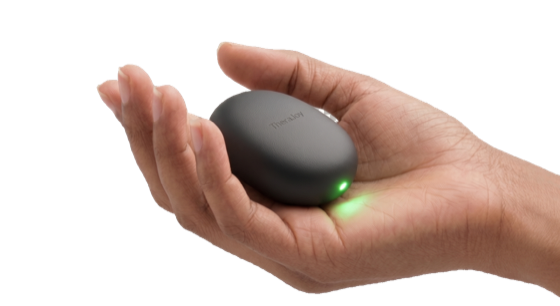
The Pebble is a pair of palm-sized wireless haptic devices — no screen, no heater, no sensors. Shipping late 2026.
Read about the Pebble →