What You Find on Amazon
Search "EMDR tappers" or "bilateral stimulation device" on Amazon and you'll find a range of handheld buzzers, EMDR pulsers, and bilateral tappers priced between $20 and $60. Most ship from overseas. The product photos often look clinical — wired controllers, handheld units, a small box — and the descriptions use the right vocabulary.
The price is appealing. But there are a few things to check carefully before using any of these clinically.
What to Check Before Buying
- →True left-right alternation. Many generic tappers vibrate both hands simultaneously or alternate so quickly the distinction is unclear. Test this before your first client session: hold one unit in each hand and feel whether there's a clean, perceptible left-right pattern. If both vibrate at once, it's not a true bilateral stimulator.
- →Speed adjustment. EMDR protocols call for different pacing depending on the phase — faster for active reprocessing, slower for grounding and resourcing. Most Amazon tappers offer a single fixed speed or a narrow range. If you can't change the pace, you're working with one setting for everything.
- →Intensity control. Some clients need a lighter touch; others benefit from stronger stimulation. Fixed intensity means you can't adapt to the client in the room.
- →Return policy. Quality control on generic hardware is inconsistent. If a unit arrives defective or the alternation isn't clean, your ability to return it depends on the seller's policy — which varies widely on Amazon.
What Amazon Tappers Don't Do
None of the generic Amazon tappers support teletherapy. If your practice includes remote sessions, the tapper in your desk drawer doesn't help your client at home. You'd need to ship hardware to each remote client, which quickly erodes the cost savings.
There's also no software layer. You can't update the firmware to fix a timing issue, adjust a haptic pattern, or add a new protocol preset. What you buy is what it is, indefinitely.
When Amazon Tappers Still Make Sense
If you need a physical device for a client who doesn't have a smartphone — or you're equipping a single in-person client for whom no app alternative is practical — a $30 Amazon tapper that passes the alternation test can work. Verify it first, and keep your expectations calibrated: it will do one thing, with fixed settings, in the room with you.
The Alternative
TheraJoy is an iPhone app that turns Joy-Con controllers into precision haptic bilateral stimulators. Speed is adjustable from 0.25 to 3 Hz. Intensity has multiple levels. For teletherapy, the client downloads the app free and joins your session via a shared code — no shipping, no hardware cost to them.
TheraJoy is free to download with a 7-day trial. Before spending anything on Amazon, it's worth trying what's already on your phone.
Common questions
Are the EMDR tappers on Amazon any good?
Quality varies more than the listings suggest. The well-known clinical brands also sell there and are what they claim to be. Below them sits a large tier of unbranded vibrating devices repackaged as EMDR tappers, where the speed range, intensity control and build are frequently not what the listing implies.
What should I check before buying EMDR tappers on Amazon?
Whether the speed range is stated as an actual figure rather than described as adjustable; whether intensity is controllable separately from speed; whether alternation stays accurate across a long set; what the return window is; and whether the seller is the brand or a reseller. Listings that avoid stating a Hz range usually avoid it for a reason.
Are cheap Amazon EMDR tappers safe?
The stimulation itself is low-risk, but EMDR is not something to run unsupervised on the strength of a cheap device. Bilateral stimulation is a component of a therapy protocol, not the therapy. If you are processing trauma, the device matters far less than working with a trained clinician.
What is the alternative to buying tappers on Amazon?
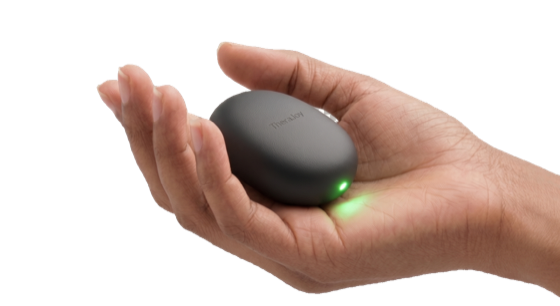
An app on hardware you already own. TheraJoy delivers tactile stimulation through Joy-Con controllers or the iPhone's own haptics, plus visual and auditory modes, from $49 a year after a free 7-day trial. If you want a dedicated object rather than a phone, the Pebble is in development for late 2026.
Hardware · In development
If you would rather hold a dedicated object
The Pebble is a pair of palm-sized wireless haptic devices — no screen, no heater, no sensors. Shipping late 2026.
Read about the Pebble →