The best EMDR tapper for your practice depends on a few practical questions: Do you do teletherapy? Do your clients have iPhones? Do you need to equip one client or many? This guide covers the main options honestly, including where hardware still wins.
The Options
TheraTapper
TheraTapper makes a focused line of tactile EMDR devices — handheld pulsers that connect to a small controller unit via wired or wireless connection. The hardware has a solid clinical feel, physical weight in the hand, and a dedicated form factor that many clinicians prefer. Pricing runs $100–$450 depending on model and bundle.
Speed and intensity are adjustable. The company has been around long enough to have a track record and clinical credibility.
NeuroTek
NeuroTek is the original professional standard in EMDR tactile stimulation, used in the early research that established EMDR's evidence base. Devices run $200–$600 and have a deliberately clinical, instrument-like quality. The company offers wired and wireless options.
If you trained in EMDR using NeuroTek equipment and want your practice to match that experience, this is a defensible choice. The brand carries weight in clinical settings.
Generic Amazon tappers
A range of bilateral stimulation buzzers and tappers appear on Amazon from $20–$60. Quality varies significantly. The primary concern with generic tappers is whether they truly alternate — many buzz both hands simultaneously or have timing drift that makes the left-right distinction unclear. Before using any Amazon tapper clinically, verify the alternation is clean.
No speed adjustment and no teletherapy support are common limitations. Return policies vary.
TheraJoy
TheraJoy is an iPhone app that uses Joy-Con controllers as haptic EMDR tappers. Joy-Cons use linear resonance actuators — the same haptic hardware class as iPhone's Taptic Engine — producing clean, distinct taps with precise timing. Speed is adjustable from 0.25 to 3 Hz; intensity has multiple levels. Subscription is $49–$79 per year; the app is free to download with a 7-day trial.
For teletherapy, the client downloads the app free and joins the therapist's session via a shared code. The therapist controls pacing throughout. For practices equipping many clients, each client uses their own device — there's no per-device hardware cost to the clinician.
Full Comparison
| Feature | TheraTapper | NeuroTek | Amazon tappers | TheraJoy |
|---|---|---|---|---|
| Price | $100–$450 | $200–$600 | $20–$60 | Free trial · $49–$79/yr |
| Teletherapy | Requires shipping | Requires shipping | No | Yes — client joins free |
| Client needs own device | Yes, or borrow from clinician | Yes, or borrow | Yes | Joy-Cons optional |
| Adjustable speed | Yes | Yes | Usually fixed | Yes — 0.25 to 3 Hz |
| Free trial | No | No | No | 7 days |
| Platform | Dedicated hardware | Dedicated hardware | Dedicated hardware | iPhone + Joy-Con |
When Hardware Still Wins
For a detailed side-by-side on TheraJoy and TheraTapper specifically, see the full TheraJoy vs. TheraTapper breakdown. For the full hardware vs. app comparison including web-based options, that guide covers the whole category.
There are real cases where dedicated hardware is the better call. If your clients reliably don't have iPhones, or if a particular client has a strong sensory preference for the weight and feel of a dedicated physical device, hardware is the right choice. The physical heft of a NeuroTek or TheraTapper is something an app can't replicate. Some clinicians also prefer having a single, dedicated instrument they control fully — no apps, no Bluetooth, no pairing steps.
If that's your situation, TheraTapper at the $100–$200 tier is probably the most sensible hardware choice for a new practice. NeuroTek if brand matters to you clinically.
Common questions
What are the best EMDR tappers in 2026?
It depends entirely on whether you are working alone or with a therapist, and whether sessions happen in a room or over video. Dedicated hardware from established makers is well built and needs no phone. An app is cheaper, travels with you, and is the only option that lets a therapist drive the stimulation remotely. Neither is universally better.
How much do EMDR tappers cost?
Dedicated tapper sets generally sit between $100 and $450 a pair, usually with a wired control box. TheraJoy costs $49 a year for solo use or $79 a year for therapists hosting remote sessions, after a 7-day trial that does not ask for a card.
Do you actually need tappers for EMDR?
No. Bilateral stimulation can be tactile, visual or auditory, and the evidence does not establish that one modality is required. Tactile is often preferred because it works with the eyes closed and is less conspicuous than following a light bar, but it is a preference rather than a requirement. TheraJoy includes all three so you are not locked into the choice.
What should I look for in a set of EMDR tappers?
Adjustable speed across a genuinely useful range, intensity you can set per person, reliable alternation without drift over a long set, and something that does not need charging or pairing mid-session. If you work remotely, add the therapist's ability to control the client's device, which rules out most hardware.
Is there hardware from TheraJoy?
The Pebble is in development for late 2026: a pair of palm-sized wireless haptic devices with no screen, no heater and no sensors, for people who would rather not hold a phone or a game controller. Until it ships, tactile stimulation in the app comes from Joy-Con controllers or the iPhone itself.
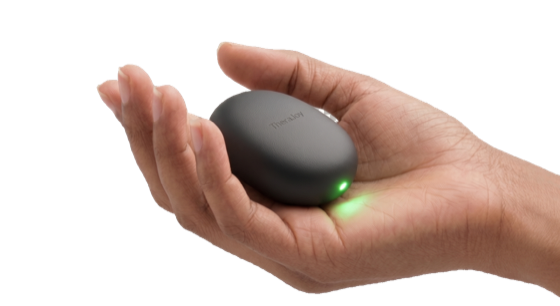
Hardware · In development
If you would rather hold a dedicated object
The Pebble is a pair of palm-sized wireless haptic devices — no screen, no heater, no sensors. Shipping late 2026.
Read about the Pebble →