Two Ways to Do Tactile BLS
Tactile bilateral stimulation (BLS) in EMDR therapy requires alternating haptic input to both hands. Historically, this meant dedicated hardware — handheld buzzers or pulsers connected to a controller unit. In the last few years, app-based approaches have become a viable alternative for many clinicians. The two categories have genuine tradeoffs.
The Hardware Landscape
NeuroTek ($200–$600)
The original clinical standard, used in the foundational EMDR research. NeuroTek devices have a deliberately instrument-like quality and significant brand credibility in established practices. Wired and wireless options available. The cost and lack of teletherapy support are the main constraints.
TheraTapper ($100–$450)
Purpose-built EMDR tactile pulsers with a focused product line. Physical weight, clinical feel, and dedicated form factor. A strong choice for in-office work where the clinician wants to control dedicated hardware. No teletherapy support without additional logistics.
Generic Amazon buzzers ($20–$60)
A broad range of quality. The main risk is alternation: many don't truly alternate left-right, which undermines the clinical purpose. Worth verifying before any clinical use. No speed adjustment, fixed intensity, no teletherapy.
The App Landscape
TheraJoy (iOS · Joy-Con haptics)
An iPhone app that uses Joy-Con controllers as haptic bilateral stimulators. Joy-Cons use linear resonance actuators — producing precise, clean taps rather than generic buzz — driven by software with adjustable speed (0.25–3 Hz) and intensity presets. Built for teletherapy: the client downloads the app free and joins by code, the therapist controls pacing. Free to try, $49–$79/yr.
Web-based EMDR apps
Several browser-based tools offer visual or auditory bilateral stimulation. Most don't offer haptic feedback at all — the screen lightbar or audio tones serve as the BLS channel. For clients who can't use tactile BLS, these are a reasonable option, but they don't replicate the handheld tapper experience.
Hardware vs. App Compared
| Feature | Hardware tappers | App (TheraJoy) |
|---|---|---|
| Cost | $20–$600 one-time | Free to try · $49–$79/yr |
| Teletherapy | Requires shipping hardware | Client joins free by code |
| Haptic quality | Varies (NeuroTek/TheraTapper: high · Amazon: low) | High — LRA haptics, same as iPhone Taptic Engine |
| Client barrier | Must own or borrow hardware | Download free (Joy-Cons optional) |
| Setup | Out of box | ~2 min Bluetooth pair |
| Updates | Fixed at purchase | App updates add features over time |
| Free trial | No | 7 days |
When Hardware Still Makes Sense
There are situations where dedicated hardware is the right call. If you work with clients who don't own smartphones, hardware is the only option for tactile BLS. Some clients also have a strong sensory preference for the physical weight of a dedicated device — a TheraTapper or NeuroTek has a specific heft that a Joy-Con doesn't replicate, and for some clients that matters.
Some clinicians simply prefer keeping all clinical equipment separate from consumer software. That's a legitimate position and dedicated hardware supports it cleanly.
When an App Is Better
For teletherapy, an app is almost always the better answer. Shipping hardware to remote clients before sessions adds logistics, cost, and points of failure. With TheraJoy, the client downloads the app free and joins your session by entering a code.
For practices working with multiple clients, the economics shift sharply: every new client downloads the app rather than requiring a new hardware purchase. And for clients who already own Joy-Cons — a significant fraction, given Nintendo Switch's 140 million unit install base — the barrier to starting is zero.
Common questions
Is an EMDR app as good as dedicated tappers?
For the stimulation itself, the meaningful variables are timing accuracy, adjustable speed and adjustable intensity, and an app on modern hardware delivers all three. Where dedicated tappers still win is independence from a phone and a physical object that is only ever one thing. Where the app wins is cost, portability and remote control.
What does hardware do that an app does not?
It works without a phone, it cannot be interrupted by a notification, and some clients simply prefer holding a dedicated object over a controller or a handset. For clients who find phones activating, that is a real clinical consideration rather than a preference.
What does an app do that hardware does not?
A therapist can run the session from somewhere else. On the Pro plan you host a session, the client joins free with a code on their own device, and you control speed, intensity and modality live while you talk over any video platform. No hardware set does that, because the therapist is not in the room to touch it.
Which one costs less?
The app, by a wide margin. Dedicated sets run roughly $100 to $450 a pair. TheraJoy is $49 a year solo or $79 a year for therapists, and clients joining a hosted session pay nothing at all.
Can you use both?
Yes, and plenty of clinicians do. Hardware in the room, the app for remote sessions and for clients who want to keep working between appointments. They are not mutually exclusive.
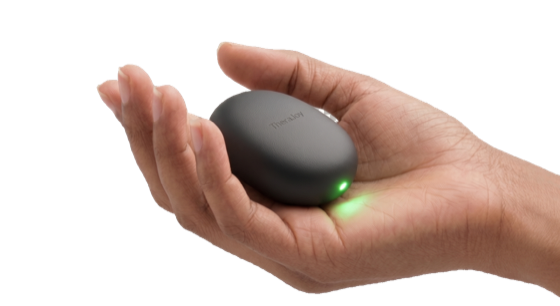
Hardware · In development
If you would rather hold a dedicated object
The Pebble is a pair of palm-sized wireless haptic devices — no screen, no heater, no sensors. Shipping late 2026.
Read about the Pebble →